Small Teams Need Security That Can Beat the Attacker’s Clock.
Google Threat Intelligence Group describes agentic cyberattacks that remain crude. They scan, make mistakes, retry commands, and leave forensic evidence.
Yet they succeed.
Google documented ARTEX execution bursts lasting just 2–25 seconds. Autonomous tools can act, interpret results, troubleshoot failures, and proceed without waiting for a human operator.
The innovation is often the compression of time between familiar attack techniques.
Now consider a small organization.
A major bank may have a 24/7 security operations center, automated response, and dedicated specialists. A municipality, school district, small hospital, or business may have one or two IT professionals responsible for everything.
The attacker operates at machine speed in both environments. The defenders have very different resources.
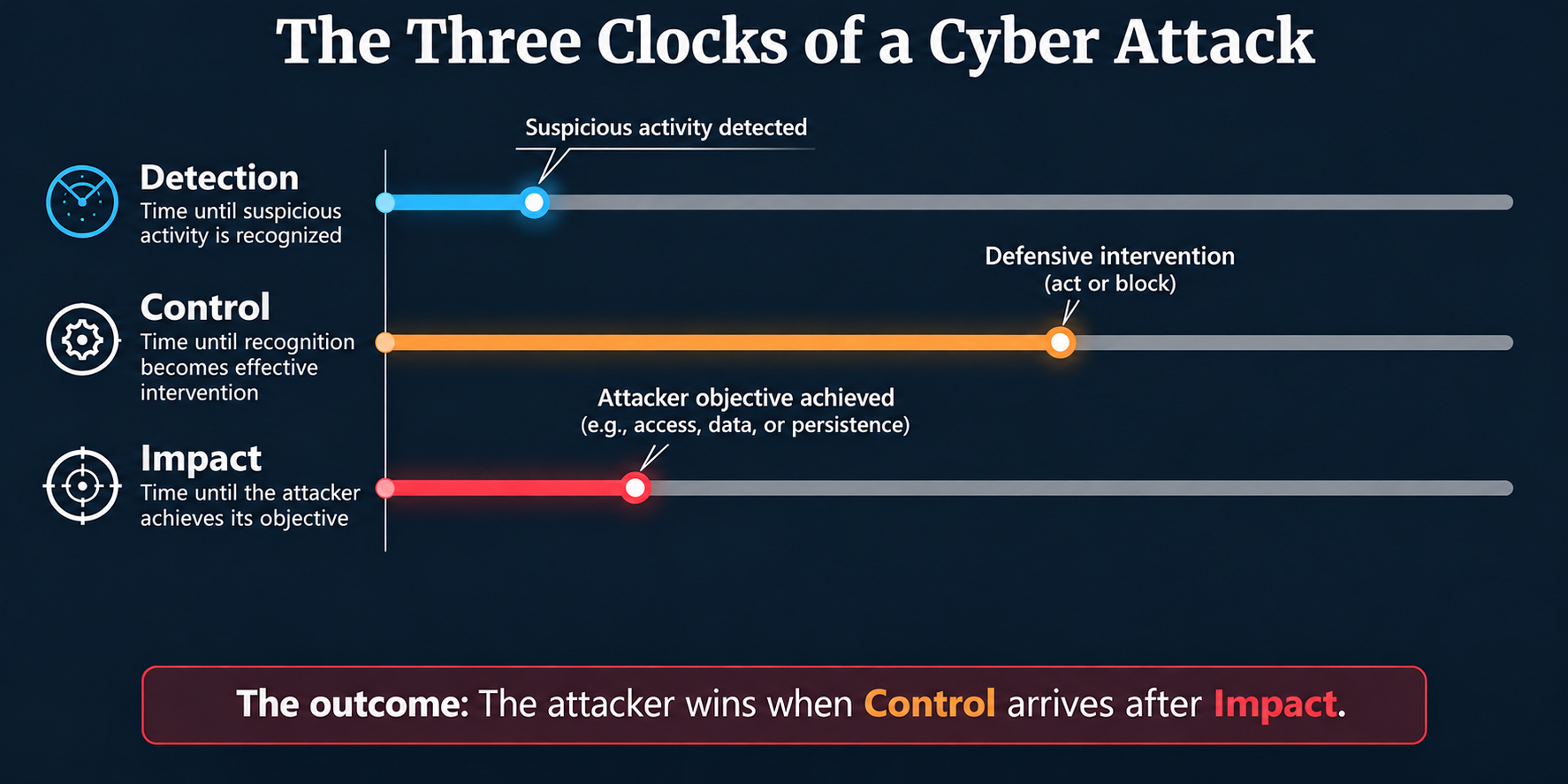
Three clocks govern an intrusion:
Detection: How long until suspicious activity is recognized?
Control: How long until recognition becomes effective intervention?
Impact: How long until the attacker achieves its objective?
The defender must detect and intervene before the attacker reaches its objective.
Smaller organizations may take longer to detect an attack because they have fewer monitoring tools. Intervention can take longer still when the person investigating an alert is also supporting users and keeping essential systems running.
Meanwhile, the attacker’s clock keeps running.
An attack can be noisy, correctly detected, and still succeed.
This changes how we should think about affordable cybersecurity. Purchase price is only part of the cost. Someone must configure tools, interpret findings, investigate alerts, and decide when to act.
For a small team, an inexpensive tool can create an expensive operational obligation.
AI can accelerate detection and response. But faster analysis alone cannot guarantee timely intervention.
The priority should be security that requires fewer decisions under attack.
Where authorization is established in advance, unauthorized connections can be denied by policy. Intercepting unauthorized reconnaissance at first contact can disrupt discovery and constrain movement without waiting for an analyst.
Ridgeback Network Defense was built for this problem.
Operating directly on internal networks without endpoint agents, Ridgeback provides device visibility, enforces network access policies, and uses synthetic network assets to intercept unauthorized reconnaissance.
These controls operate without an analyst first classifying activity as malicious. Detection and incident response remain essential, but they need not carry the entire burden.
The smaller your security team, the less your security architecture can depend on someone being available to make the next decision.
The attacker does not adjust its speed to your staffing level.
Ridgeback helps your defenses operate without having to match it.